
New York City Isn't a Backdrop for Experiential Marketing.
It's the Brief.
On February 9, 2024, a Canal Street souvenir shop in Chinatown became a MAC Cosmetics activation for Fashion Week.
Knockoff handbags and "I heart NY" shirts had filled that same shop for years.
The shell stayed raw and unfinished, rather than getting gutted for a polished flagship look.
Makeup stations, a 30-plus-piece customized merch shop, a live performance stage, a full bar, and a food truck all went into that same footprint.
The timeline left no room for a second attempt.
Experiential marketing in New York City rarely looks like the market-size decks agencies use to pitch the city.
The venue arrives with its own history built in, whether that's a souvenir shop's grime or a gallery's white walls.
The job is designing with that history instead of erasing it.
Five real activations, from a Chinatown storefront to a citywide scavenger hunt, show what that actually requires.
Every Neighborhood Writes Its Own Design Brief
The MAC Market took over a Canal Street shop's grime on purpose.
The fresh Black Tea Serum launch needed the opposite instinct entirely.

That meant Artists' House in Chelsea, a room built with four full walls of LED paneling.
It was designed for immersive visual work, not for seating guests around a dinner table.
Rather than swap venues, a full catering and staffing operation got built around the room's actual purpose.
The serum's story got told through the space itself instead of around it.
Spatial fit in New York City rarely means finding the perfect empty box.
It means reading what a space was actually built to do, then deciding whether to work with that intention or against it.
A Chinatown souvenir shop and a Chelsea gallery-style venue don't share a floor plan, a foot-traffic pattern, or a lighting rig.
They share a city, and a city is the only thing a moodboard from another market can't replicate.
Density Compresses the Runway Before Anyone Designs Anything
Shark Beauty's "Unwrap Something Different" activation had one month between brief and event day.

It ran on a SoHo sidewalk with no room to expand.
More than 10 cohesive branded touchpoints went into that single small footprint instead of spreading the concept across a bigger site.
Gift-wrapped hair tools, branded envelopes with discount cards, and complimentary popsicles for guests waiting in line all had to work inside the same tight radius.
The activation still cleared its own target: over 110 QR code scans against its own call-to-action.
More than 1,000 guest engagements and over 1 million social media impressions followed, all inside that one-month window.
New York City's density doesn't just shrink footprints.
It shrinks timelines, too.
Every other brand activating that same week is competing for the same SoHo blocks, the same press attention, and the same influencer calendars.
A slower market gives an agency room to test concepts before committing.
New York City asks for the committed version on the first try.
What Makes New York City Different From Other Experiential Markets?
New York City is one of the only markets where a single-day activation can treat the entire city as its venue.
For Nike's JDI Day, WONU built a citywide scavenger hunt that moved employee teams between Nike's headquarters, sports courts, parks, and cultural landmarks.

More than 10 branded elements were scattered across the day.
WONU's own description of the approach: turning "the city into their playground."
That kind of format doesn't work in a market with one convention center and a handful of interchangeable event venues.
It works because New York City has enough distinct, recognizable locations within a short travel radius.
A single day can move through several of them and still read as one coherent story.
Venue density is the real New York City advantage, more than population size or tourist volume.
A brand can build a narrative arc across five stops in one afternoon without ever changing cities.
WONU's strategy and experiential marketing practice treats that density as a planning asset, not a logistics problem to route around.
Working Inside Someone Else's Citywide Moment
Not every New York City activation is a brand's own show.
CultureCon's Brooklyn conference gave WONU a different kind of brief: build inside somebody else's citywide cultural moment.

WONU worked in partnership with Beyond8, the event's producer.
WONU handled eight distinct branding components across the conference footprint.
Three separate stage set designs, a merch shop, a talent portrait studio, registration walls, wayfinding, and staffing uniforms were among them.
The goal wasn't a single hero moment.
It was cohesion across a full day of programming.
Every moment was created to feel tied to the last, with each space still having its own distinction, down to the rugs and chairs.
Brooklyn adds its own texture to that brief.
A conference audience arriving in Brooklyn expects a different visual language than one arriving in Midtown.
The wayfinding and staffing choices have to read that difference correctly.
WONU's creative direction and spatial design work in Brooklyn is built around exactly that kind of borough-specific fluency.
New York City Is Where Brands Come Back To
Fendi and Skims tested their collaboration pop-up on Rodeo Drive first.
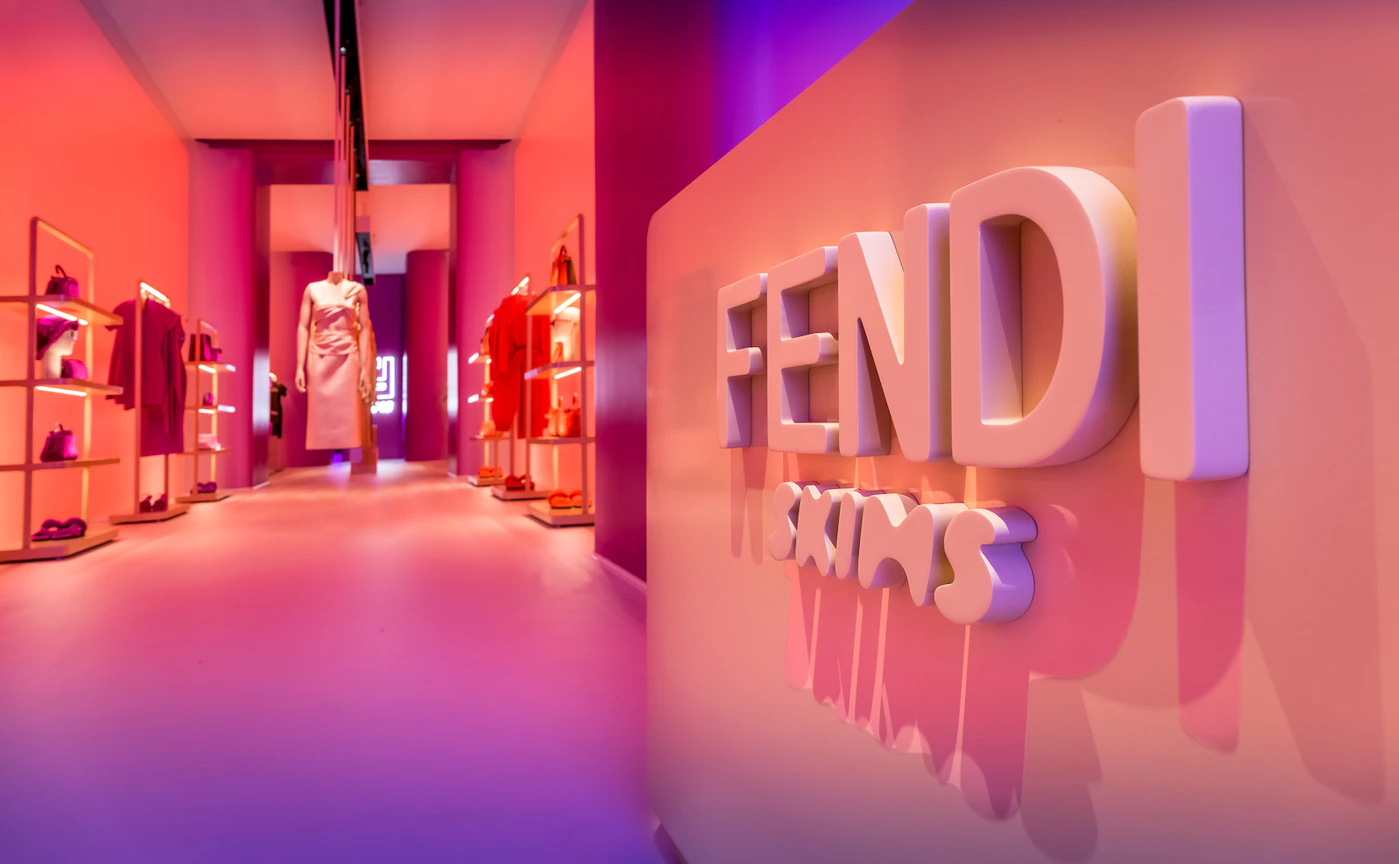
It performed well enough to run for eight-plus months and five additional collection rollouts in that same Los Angeles space.
New York City wasn't the launch market.
It came next, once the concept had already proven itself elsewhere, in two further executions.
That pattern repeats.
Fresh Beauty ran its Black Tea Serum launch in both New York City and Los Angeles.
The New York City leg carried the heavier production lift: full catering and staffing built into a room engineered for LED visuals, not dinner service.
Brands don't necessarily choose New York City to test something new.
They choose it to prove a concept can hold up under the city's own scrutiny, its own press corps, and an audience that has already seen most of what a brand can try.
Production complexity in New York City tends to scale up, not down, once a brand's ambitions catch up with the market's expectations.
WONU's production and project management team exists for exactly that gap.
The Scale Is Real. It's Just Not the Reason.
New York City drew nearly 65 million visitors in 2024, the second-highest figure in the city's history.
That activity generated an estimated $79 billion in economic impact across the city and state, according to NYC's Mayor's Office.
Most agencies pitching the city lead with some version of that number.
The number is real, but it explains volume, not why a specific activation works.
WONU's own site visit to SoHo's African Diaspora Goods turned up a line that gets closer to it: "Retail is dying, experience is flourishing."
That flourishing depends on neighborhood-level specificity a visitor count can't capture.
SoHo's retail history reads differently than Chinatown's, which reads differently than Chelsea's gallery corridor.
An activation that ignores those differences reads as generic no matter how many people walk past it.
Measuring whether an activation actually landed, instead of just counting foot traffic past the storefront, is its own discipline.
WONU has written about what that measurement should track beyond visitor totals.
WONU's creative direction and spatial design work in SoHo starts from that neighborhood-level reading, not from the citywide visitor total.




Frequently Asked Questions
The City Is a Collaborator, Not a Backdrop
A Canal Street souvenir shop. A Chelsea room built for anything but dinner. A SoHo sidewalk with no room to expand.
None of these are obstacles a New York City activation works around.
They're the actual material of the work.
That's a different premise than the one most experiential marketing content about New York City starts from.
The city isn't a backdrop with good lighting and a lot of foot traffic.
It's a collaborator with its own opinions, built into every neighborhood and every timeline a brand tries to work inside.
Getting that reading right, neighborhood by neighborhood, project by project, takes more than good taste.
It takes a production team that has actually built inside a Canal Street shell, a Chelsea gallery-style room, a Brooklyn conference floor, and a citywide scavenger hunt.
That team knows the difference in what each one demands.
If your brand is planning to activate in New York City and wants that neighborhood-level thinking from the first conversation, start a conversation with our team.
Let's build
If you're thinking about how your brand shows up in the world, we'd love to hear from you.