

Fendi X Versace “Fendace” Collaboration Case Study:
Two Brands, One World
This Fendi X Versace “Fendace” collaboration case study explores one of the most audacious creative exchanges modern luxury has seen.
You've surely seen plenty of collaborations before; limited sneakers, capsule collections, the usual playlist. However, when Fendi and Versace unveiled “Fendace” in September 2021, they didn’t announce a typical partnership.
They handed over authorship, swapping creative DNA entirely.
Kim Jones designed for Versace, while Donatella Versace took the reins at Fendi, turning a Milan runway into a live experiment in trust, risk, and brand clarity.
What followed was more than a collection. It became the blueprint for how heritage brands can collaborate without losing themselves, proving that sometimes the boldest move is letting go.
This case study examines how that moment unfolded and why it remains significant.
Why the Fendace Collaboration Happened
By 2021, luxury fashion was at an inflection point.
Heritage alone was no longer enough to command consumers’ attention, and novelty without substance felt hollow. The industry was seeking new forms of cultural relevance, and collaborations had become both a creative risk and a strategic commercial approach.
Against that backdrop, Fendi and Versace made a move few expected, and even fewer would attempt.
Rather than positioning one house as dominant, the collaboration treated both brands as equals. Fendace wasn’t a guest designer moment or a logo swap. It was a full-on exchange of creative authorship, with Kim Jones designing for Versace and Donatella Versace designing for Fendi.
In an industry built on guarding intellectual property, that level of openness carried real risks. Brand codes could’ve blurred, and loyal audiences could’ve rejected the premise outright.
However, timing made the risk worth taking.
Coming out of a period mainly defined by isolation and digital saturation, fashion audiences were craving a spectacle, connection, and shared cultural moments. Fendace delivered all three.
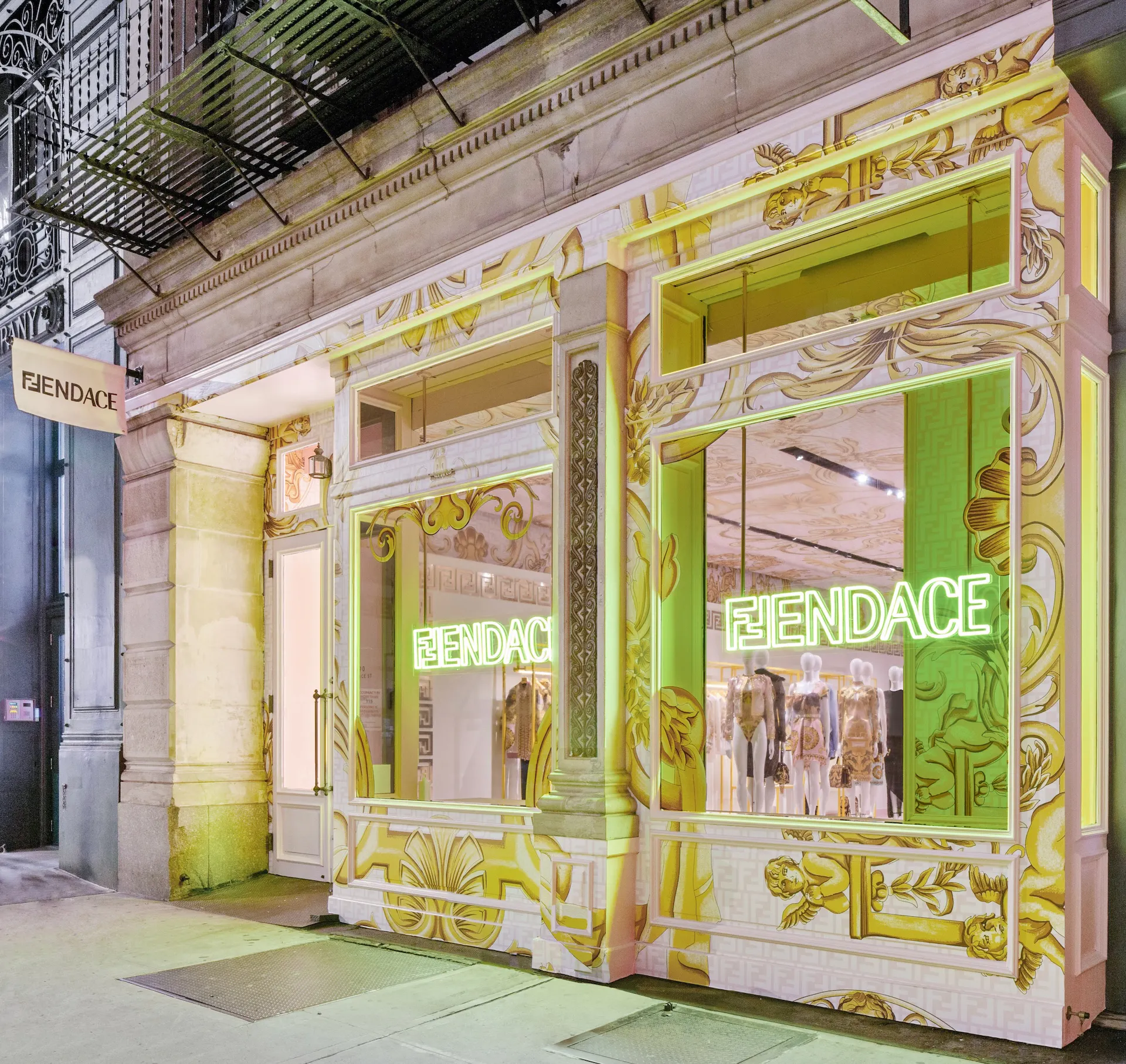
The collection leaned into boldness and excess, referencing the 1990s era that shaped Versace’s global rise while grounding the work in Fendi’s precision and material mastery. It spoke to nostalgia, without ever relying on it, and to progress without erasing history.
Moreover, this collaboration reflected a broader shift in luxury. In the same season that saw high-profile partnerships like Gucci and Balenciaga, Fendace pushed the concept further by making collaborations the core narrative rather than a marketing add-on.
The message was clear:
Cultural impact now comes from shared authorship, not isolated dominance.
At its core, Fendace was a statement about evolution. Two Italian fashion houses chose collaboration over competition, using creative trust as a growth strategy and experience as the multiplier.
When luxury brands choose collaboration with intention, the result isn’t dilution. It’s momentum.
A Creative Experiment: When Designers Swapped Houses
At the heart of the Fendace collaboration was one decision that redefined how creative partnerships could function at the highest level of luxury. Rather than co-designing from a distance, Kim Jones and Donatella Versace fully stepped into each other’s worlds.
The designers took full complete creative control within the other house, working directly from its archives, codes, and craftsmanship traditions.
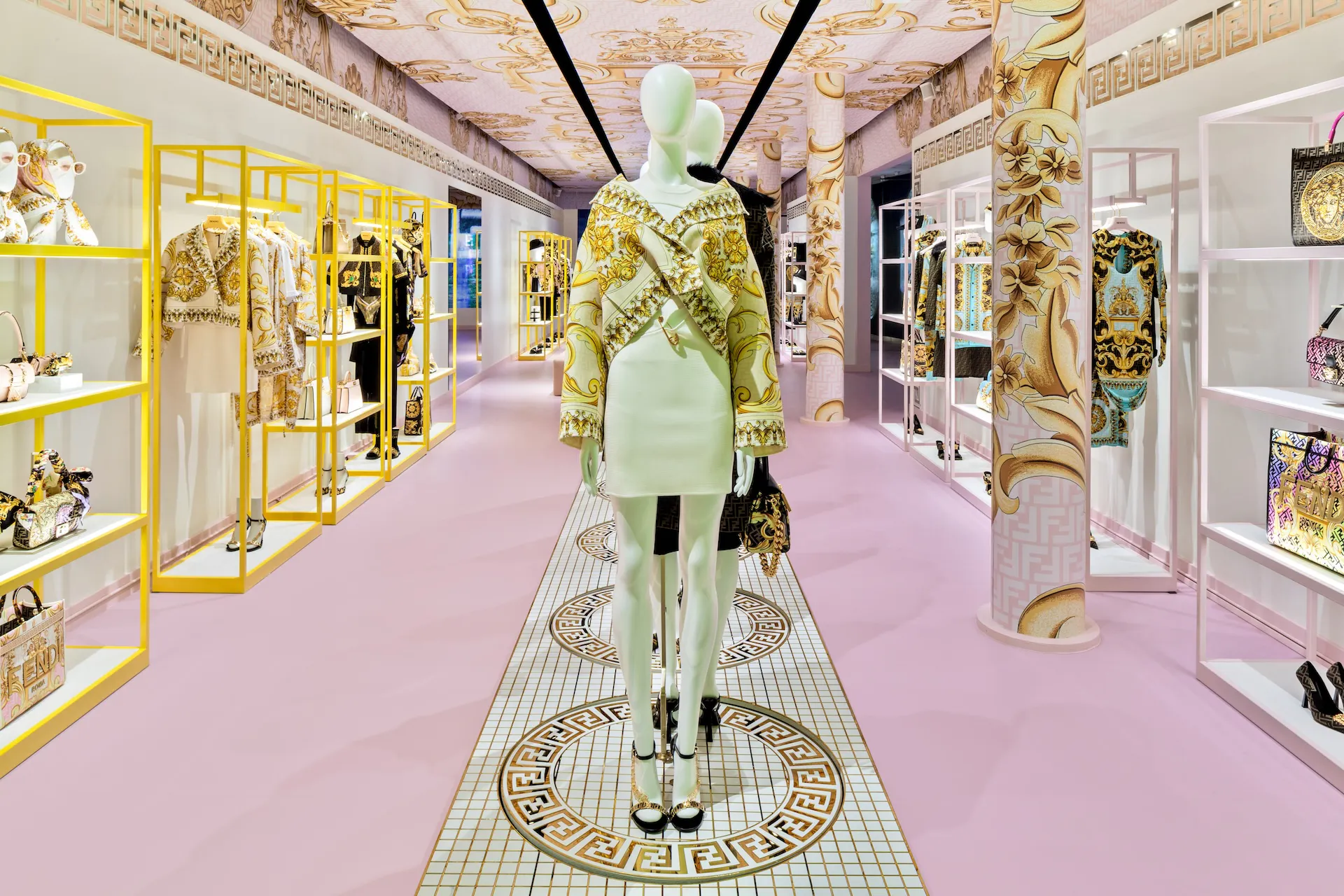
Jones approached Versace with the precision he is known for at Fendi. Immersed in the Versace archives, he revisited the bold energy of the 1990s, drawing from the era shaped by Gianni Versace. The Greek Key motifs, supermodel-era prints, and unapologetic glamour were reinterpreted through Fendi’s material rigor and tailoring discipline.
The result felt confident and familiar, yet unmistakably reframed.
Donatella Versace’s work at Fendi moved in the opposite direction. She injected edge and provocation into a house that is often associated with restraint. The crystal embellishments, metallic accents, and reworked monograms pushed Fendi silhouettes into bolder territory without abandoning their core elegance.
Her approach showed a deep understanding of Fendi’s DNA, proving that disruption can still be respectful when it’s rooted in knowledge.
What made this experiment work was creative fluency.
Neither designer tried to “overwrite” the other brand. Instead, they translated their own perspective into an established visual language. That level of trust can rarely be seen in luxury fashion, where brand equity is closely guarded, and collaboration often stops at the surface.
The designer swap turned archival research into a form of storytelling.
By engaging directly with each house’s history, Jones and Versace created collections that felt emotionally grounded and culturally resonant. The narrative later extended into physical environments, where retail experiences and displays echoed the same sense of exchange and discovery.
When creative leadership is built on trust and deep brand understanding, collaboration becomes a catalyst rather than a compromise.
Design Language: How Fendace Unified Two Iconic Brand Codes
Fendace succeeded because it treated design as a shared language rather than a branding exercise. You don't merge two luxury legacies by tucking one logo under the other, after all.
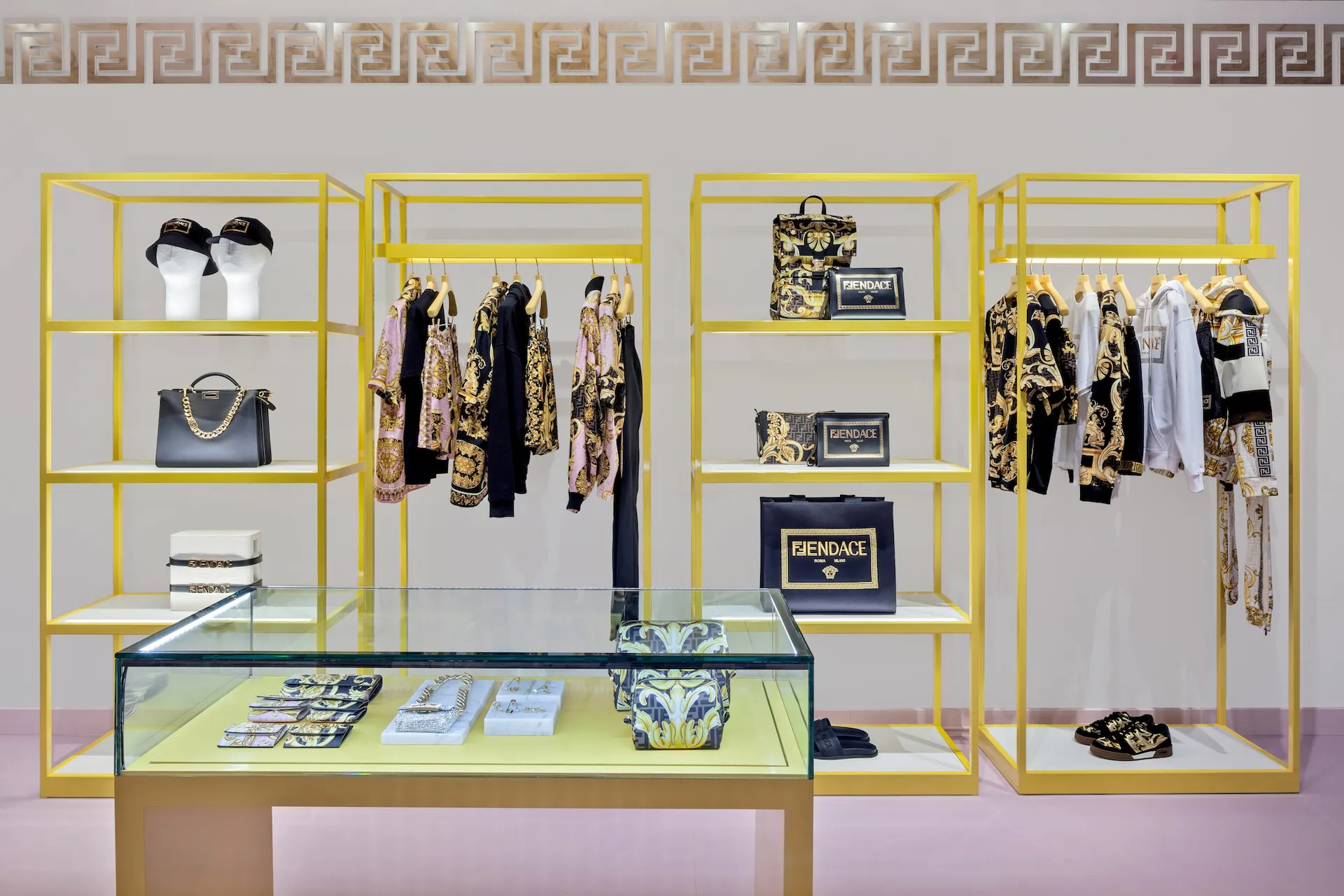
Instead of isolating the logos or alternating visual dominance, this collection allowed Versace and Fendi to occupy the same surface, often within the same motifs. Versace's Baroque swirls tangled right into Fendi's double F monogram, while Greek Key patterns morphed into geometric grids.
Neither house stepped back, and that tension became the point.
In fact, it’s what made the collaborative creativity legible.
The second factor was archival access. Nothing shuts down collaboration faster than one party refusing to share.
Both houses opened their complete archives to the other design team, allowing them to work freely within each other’s historical references, treating the archives as shared material rather than protected territory.
This exchange wasn’t about replication. It was about finding techniques that carried cultural weight, then giving them a new context.
Versace’s nineties-era exuberance and Fendi’s structural discipline met through fabrics, print density, and construction techniques. Gold acted as the visual anchor across the entire Fendace range. It appeared in hardware, embroidery, and accessories, creating cohesion across categories, without relying on repetitive graphics.
Gold mediated contrast, anchoring the collaboration visually and emotionally.
It served as the unifying element between Versace's boldness and Fendi's precision, letting product fusion feel intentional rather than chaotic.
Logo integration followed that same philosophy. Marks didn’t sit side by side as badges. They transformed into hybrid symbols, sometimes hidden within seams or linings, rewarding close inspection. This approach elevated logo design to a collectible level, reinforcing the idea that luxury thrives on discovery and detail.
Strong collaborations are built in the details. WONU helps you design unforgettable experiences.
The Runway as Reveal: Staging, Casting, and Cultural Impact
Fendace didn’t debut quietly. The collaboration closed Milan Fashion Week on September 26, 2021, with a runway format designed to be understood instantly and remembered long after.
Held at Palazzo Versace, the show unfolded in two distinct chapters. Versace by Fendi walked first. Fendi by Versace followed. The structure made the creative swap tangible, turning concept into lived experience.
By separating the collections into two halves, the audiences could see how each designer interpreted the other house without any confusion or dilution, and the message landed fast:
This wasn’t co-design. It was creative authorship exchanged in real time.
Casting reinforced that intent even further.
The runway drew from fashion’s living archive, pairing established icons with contemporary faces to signal continuity rather than nostalgia. That decision positioned Fendace as an authoritative moment, not a mere novelty drop chasing youth culture.
When Naomi Campbell closed the show, the symbolism was immediate. Her presence anchored the entire collaboration in the era that shaped Versace’s cultural dominance, and, at the same time, underscored the confidence behind the fusion.
Of course, symbolic weight took shape before the first model appeared.
The secret private event closing Milan Fashion Week in September 2021 established the visual narrative from atmosphere alone. There were no oversized sets competing with the clothes. The focus remained on movement, material, and detail.
This restraint allowed the dual brand language to speak without interruption.
Here, the runway served as a reveal rather than a performance. It established trust in the concept and set the tone for everything that followed, from the campaign imagery to the immersive retail environments. By prioritizing narrative clarity over excess, Fendace managed to transform this fashion show into a cultural signal that resonated beyond the room.
When the reveal is this deliberate, the moment becomes the message.




The Fendace campaign translated the swap into a visual world built on access, atmosphere, and attitude. Shot by Steven Meisel, the imagery framed the collection as a velvet-rope moment.
You were either invited or you were not.
Retail Strategy: Exclusivity, Distribution, and Desire
Fendace extended its creative logic all the way to the point of sale. Rather than dispersing product across multi-brand retailers, the collaboration followed a strict distribution rule.
Versace by Fendi appeared only in Fendi stores and digital channels. At the same time, Fendi by Versace lived exclusively inside Versace retail environments.
That separation was deliberate and strategic.
This approach preserved brand clarity at the most critical moment of the customer journey. Each collection remained anchored to its parent house, making it possible for shoppers to explore the guest designer’s influence without leaving a familiar ecosystem:
Fendi clients got to experience Versace through Fendi’s lens. Versace customers got to experience Fendi craftsmanship within Versace’s world.
That exchange felt intentional, even at the point of purchase, the moment when a customer decides where their loyalty lives, further reinforcing trust.
Of course, exclusivity fueled desire, too.
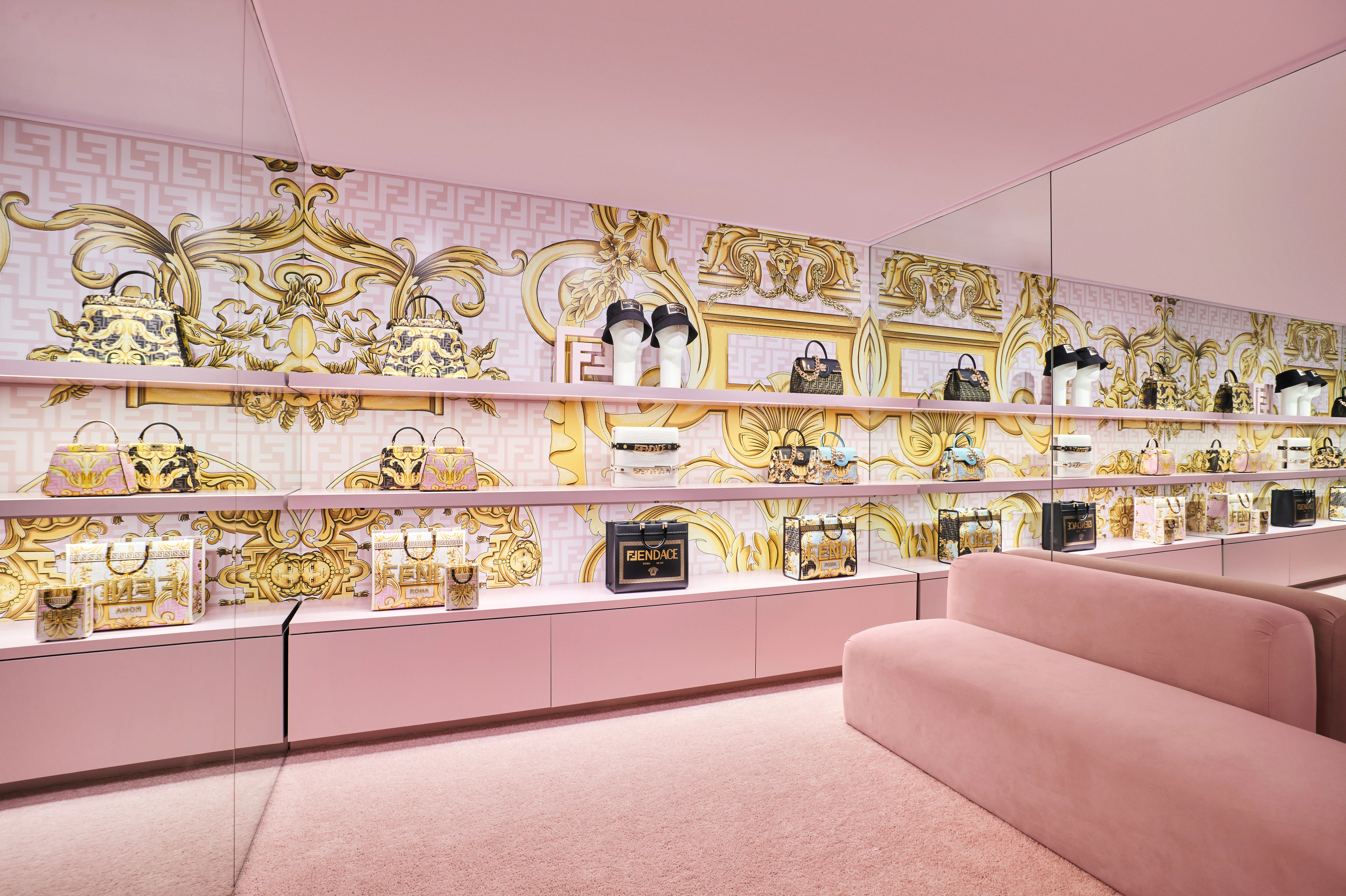
Limited access required entry into a specific brand universe, turning retail into part of the storytelling. By avoiding the widespread wholesale distribution, both houses maintained control over pacing, presentation, and context.
The floor became an extension of the narrative, not a neutral backdrop.
It’s worth noting that this model resisted a common collaboration pitfall.
Many partnerships tend to lose that narrative coherence. Fendace did the opposite. It used restriction as a design tool, aligning the product, the space, and the audience into a single experience that felt considered and rare.
The result was a retail strategy that mirrored the creative swap itself:
Exchange without erasure. Exclusivity without isolation. Desire built through clarity rather than noise.
From Concept to Space: The Global Fendace Pop-Up Experience
Fendace reached its full expression when the collaboration moved off the runway and into physical space.
In May 2022, the project translated creative exchange into experiential retail through a series of pop-ups that treated access as part of the design. These spaces weren’t supplemental retail moments.
They were the primary way to see the full Fendace collection in person.
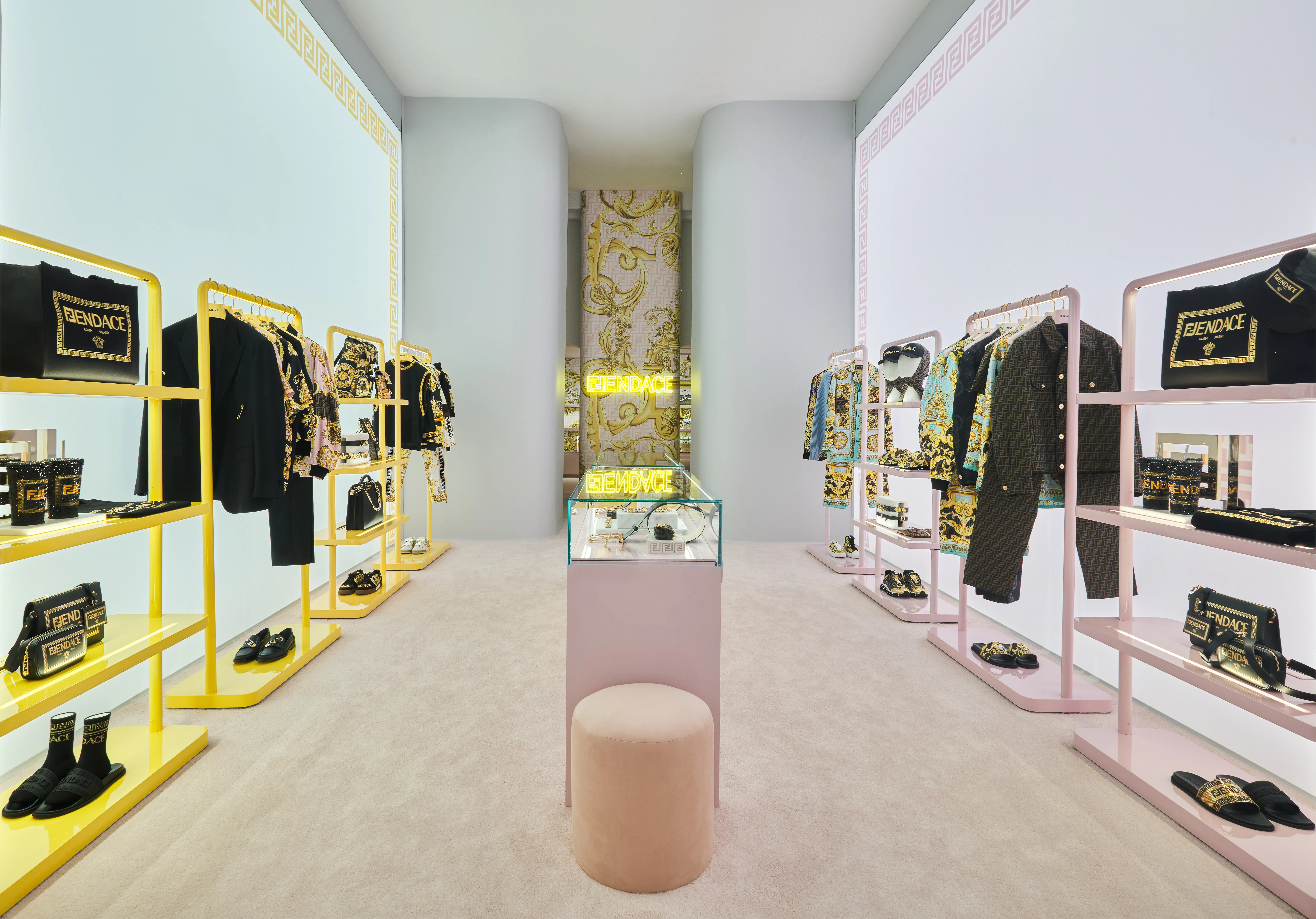
The strategy centered on intentional scarcity.
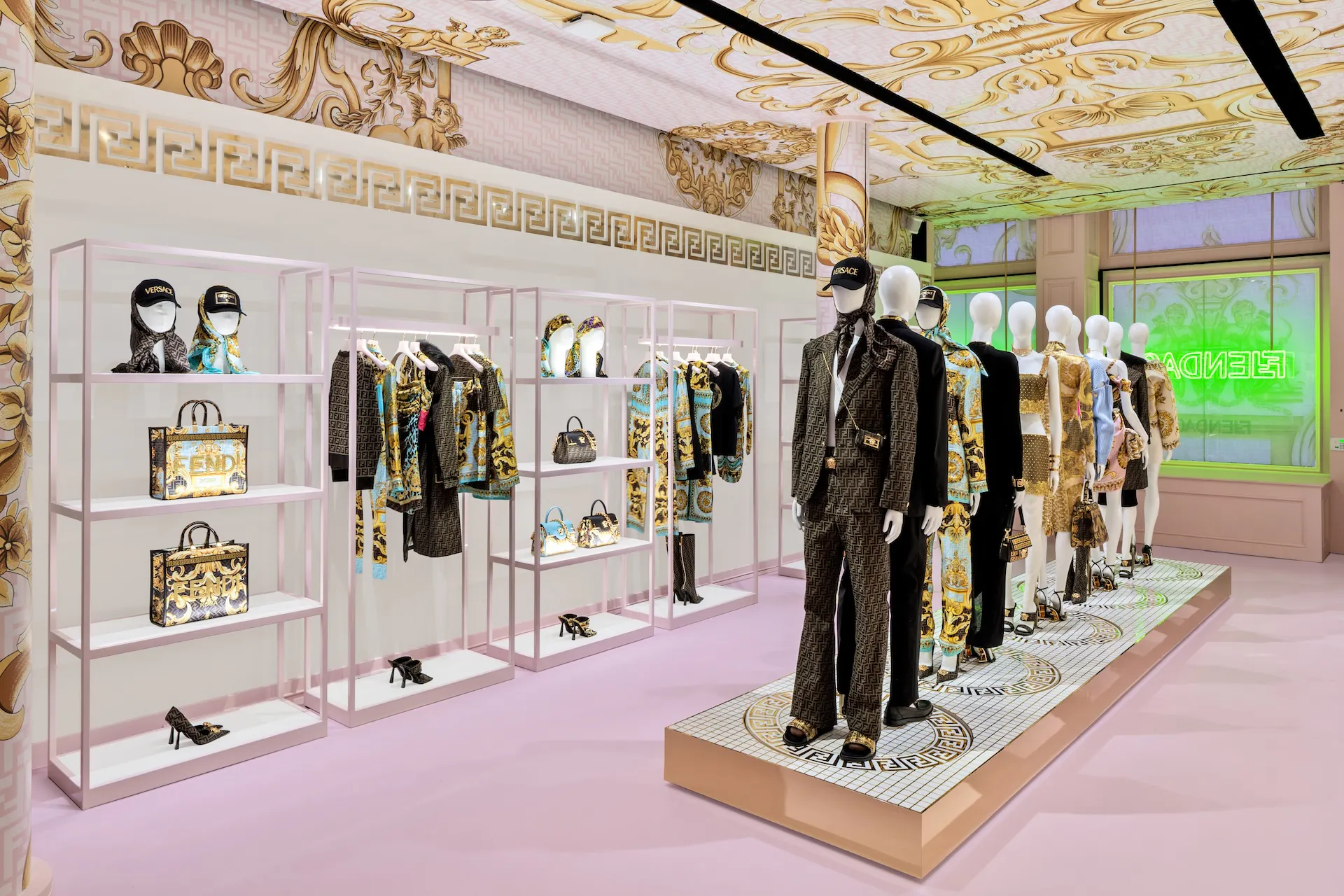
A limited number of global locations activated simultaneously, creating urgency while maintaining narrative clarity. Each pop-up reinforced the same rule that defined the collaboration from the beginning. Versace by Fendi lived within Fendi’s world, and Fendi by Versace appeared through Versace’s lens.
And here, the environment carried as much meaning as the product itself.
Experiential flow was essential here. Guests moved through the space designed to drive anticipation and discovery, with visual cues pulling directly from the collection’s design language.
Think sculptural facades, custom furniture and fixtures, and fitting rooms that became immersive moments rather than functional endpoints; elements that echo the duality at the heart of Fendace.
Temporary retail functioned as brand theater. These pop-ups were built to evolve, not to sit still, reinforcing the idea that today, luxury thrives on moments, not permanence. By limiting time, scale, and access, this experience was able to drive memory and demand.
Fans had to show up or miss out entirely.
Additionally, this approach underscored why pop-ups continue to matter for luxury brands. When executed well, they make room for storytelling, controlled context, and emotional engagement that traditional retail cannot always deliver.
Fendace proved that space can be as expressive as design, and that experiential retail remains one of the most powerful tools for translating collaboration into desire.
When the space carries the story, the experience becomes the reason people show up. WONU helps you build it.
Key Takeaways: What Fendace Taught the Industry
If there’s one thing the Fendace collaboration offered, it’s a lesson in how luxury collaborations can evolve without erasing identity.
When two luxury houses exchange creative control, brand codes stop being static assets and begin acting like live tests of visual DNA.
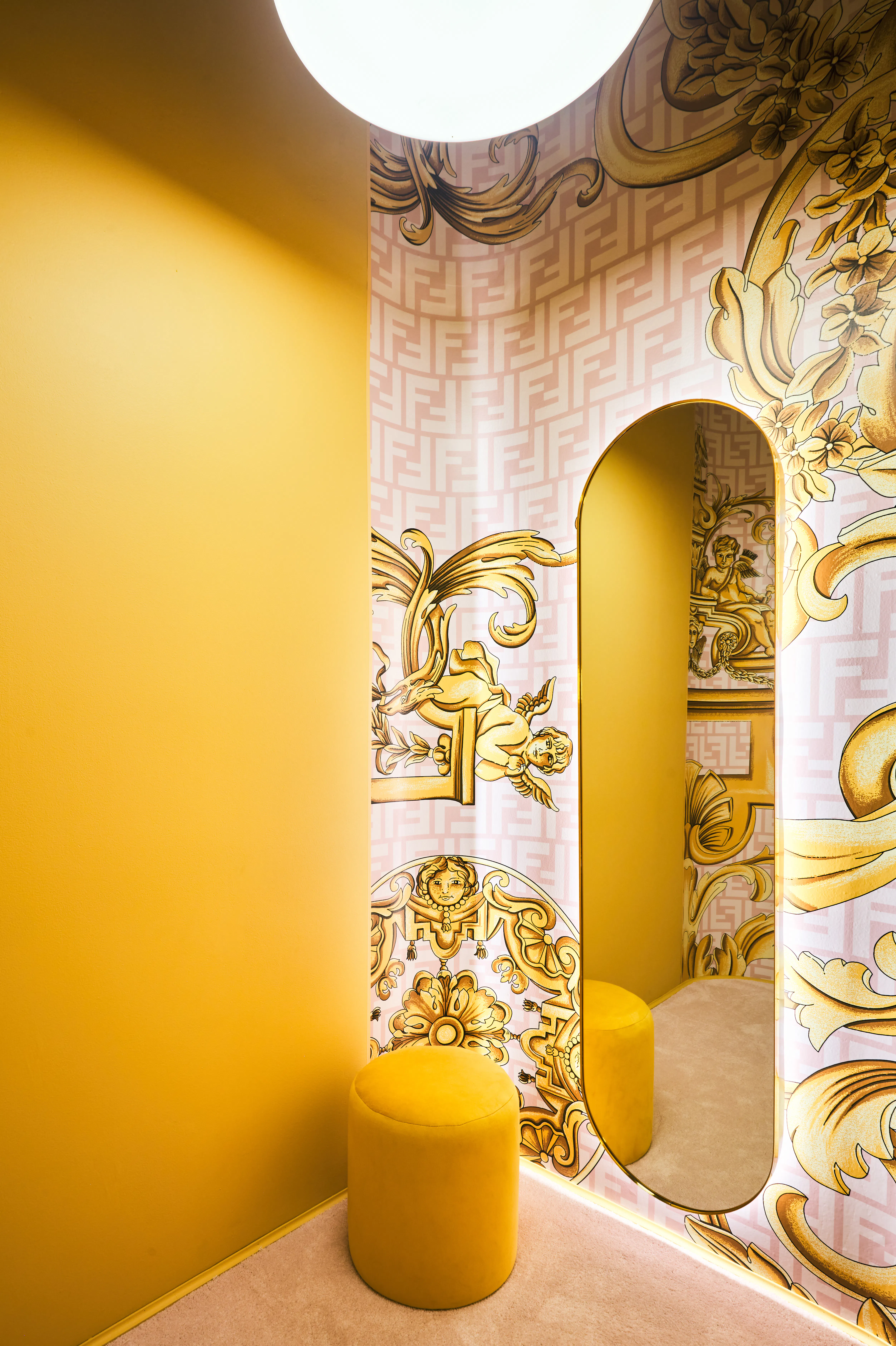
The success of the project came from restraint as much as boldness.
Of course, brand codes need to be respected before they can be reinterpreted. Fendi and Versace didn’t dilute their visual languages to meet somewhere in the middle; quite the contrary. Each house preserved the other's visual language while inserting its own craft.
Monograms, silhouettes, and motifs all retained their meaning, even as they were reshaped.
Brand identity survived because creative collaboration relied on mutual trust.
Here, experience outweighed excess. From runway staging to campaign imagery and immersive pop-ups, Fendace prioritized clarity over saturation. Think spectacle used with purpose, not as noise.
Every touchpoint reinforced the same narrative, because they knew that disruption without recognition kills desire.
Ultimately, this was not a partnership built on shared logos and surface-level alignment. It was a deliberate exchange of perspectives, craft, and responsibility. Fendace set a new benchmark for how heritage brands can move forward together.
It showed that collaborations, when rooted in mutual respect and experiential thinking, can expand cultural relevance without sacrificing identity.
The future of luxury? It belongs to brands that know who they are and are willing to create with others who do, too. Partner up with WONU to build experiences that define what comes next.
Why Fendace Still Sets the Standard
Fendace endures because it treated collaboration as a discipline, not a stunt. Every single decision, from creative authorship to retail execution, reinforced the same idea:
Identity grows stronger when it’s understood deeply enough to be shared.
It rewrote collaboration rules, not through competition, but through conversation, proving that two heritage codes can coexist without compromise.
This ultimately teaches us that modern luxury is built through intention. Brands that lead today can’t simply rely on scale or noise. They need to build worlds people want to step into, even if only for a moment.
That’s the space WONU operates in.
Turning bold ideas into physical experiences that move people, drive demand, and protect brand integrity. If this case study sparked new ideas, reach out to our team and explore how WONU develops immersive environments that turn vision into presence.
Let's build
If you're thinking about how your brand shows up in the world, we'd love to hear from you.