Five Luxury Pop-Ups:
One Failure, and the Design Decisions Behind Each
At the Fendi x Skims pop-up at 323 Rodeo Drive in November 2021, luxury pop-up shop design ran into a problem nobody briefed for in the lighting plan.
Skims' identity sits on a palette of nude shades engineered to read across a range of skin tones.
Those nudes don't reproduce inside RGB fixture programming the way a render suggests they will. Brown is not a primary wavelength.
It's a low-luminance yellow or orange that reads muddy under poorly programmed light.
WONU's lighting designer ran sampling cycles against the actual product before the install opened, programming the fixtures to the nudes themselves rather than to the room.
The collaboration ran 1,205 square feet across twenty days.
Luxury pop-up shop design lives or dies on calls like that, and most of the design pages covering pop-up retail right now don't write about them.
How we picked these five
The selection rule for this piece is stated up front so it can be argued with.
Each of the five pop-ups below carried one specific design constraint, one specific decision WONU made about that constraint, and one measurable outcome.
The sixth case is the failure: a luxury retail rollout where the constraint was timeline pressure and the outcome was repeated fixture damage.
Jade Akintola, founder of WONU Studio, picked the five from the studio's pop-up portfolio.
The criterion was whether the team could speak about the production-level decision in detail. The portfolio is wider than these five.
The ones below are the ones where the decision survives the retelling.
For a broader format overview, see pop-up shops and installations for luxury brands.
Fendi x Skims, Rodeo Drive: programming light to a palette, not a room
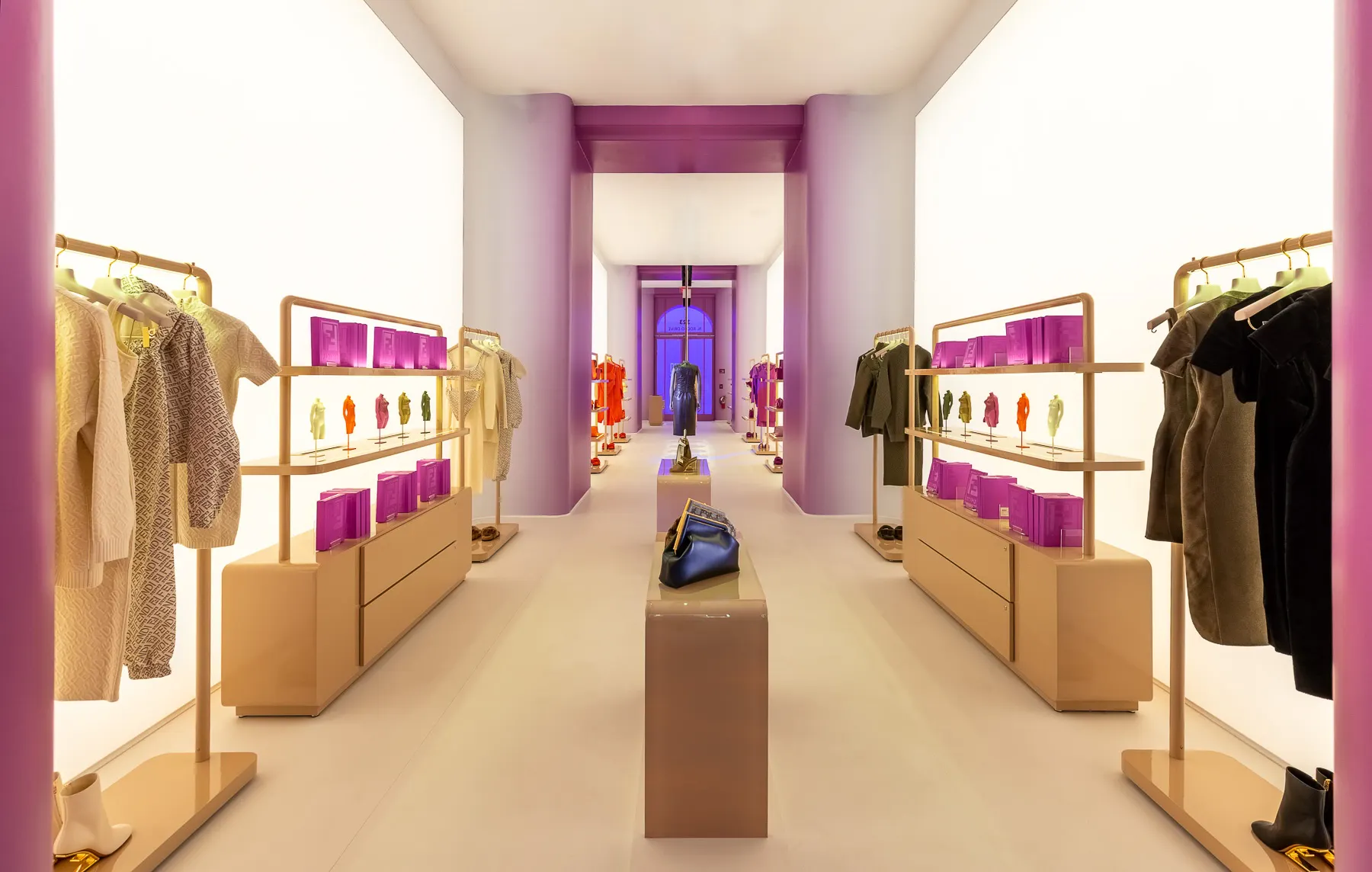
Fendi briefed WONU on a site-specific version of the global Fendi x Skims execution for Rodeo Drive.
Two partner brands, both needing to be satisfied with how their identity read in space.
The Skims half of that brief hinges on color: a palette built around nude shades that span the line's full size and skin-tone range.
The technical problem with nudes is a property of additive RGB color itself.
Fixtures generate visible color by combining red, green, and blue wavelengths.
The warmer browns and the lightest nudes sit in a portion of the spectrum where additive mixing falls short.
A Skims neutral that reads true under daylight can read green-shifted, washed, or chalky under fixtures that weren't programmed to it.
WONU brought in a lighting designer Jade had worked with before.
The team ran sampling cycles against the actual product palette, then programmed the install to that palette before opening day.
The success signal for a luxury pop-up shop design isn't always the impressions count.
For Fendi x Skims, it was duration and frequency.
The original site, reported by Haute Living, was a 1,205-square-foot space at 323 Rodeo Drive.
It extended past the original twenty-day window into eight months of continuous activity.
Fendi rotated five further collection rollouts through the same footprint, then carried the format to two more executions in NYC.
As Jade put it:
"We became the trusted partner for Fendi and their North America pop-up activation, so they could bring their collaborations to life on a highly frequent, seasonal basis, which ultimately drove sales."
Full project record: Fendi x Skims pop-up.
Canada Goose at Bloomingdale's: turning a dead sushi counter into a heritage exhibit
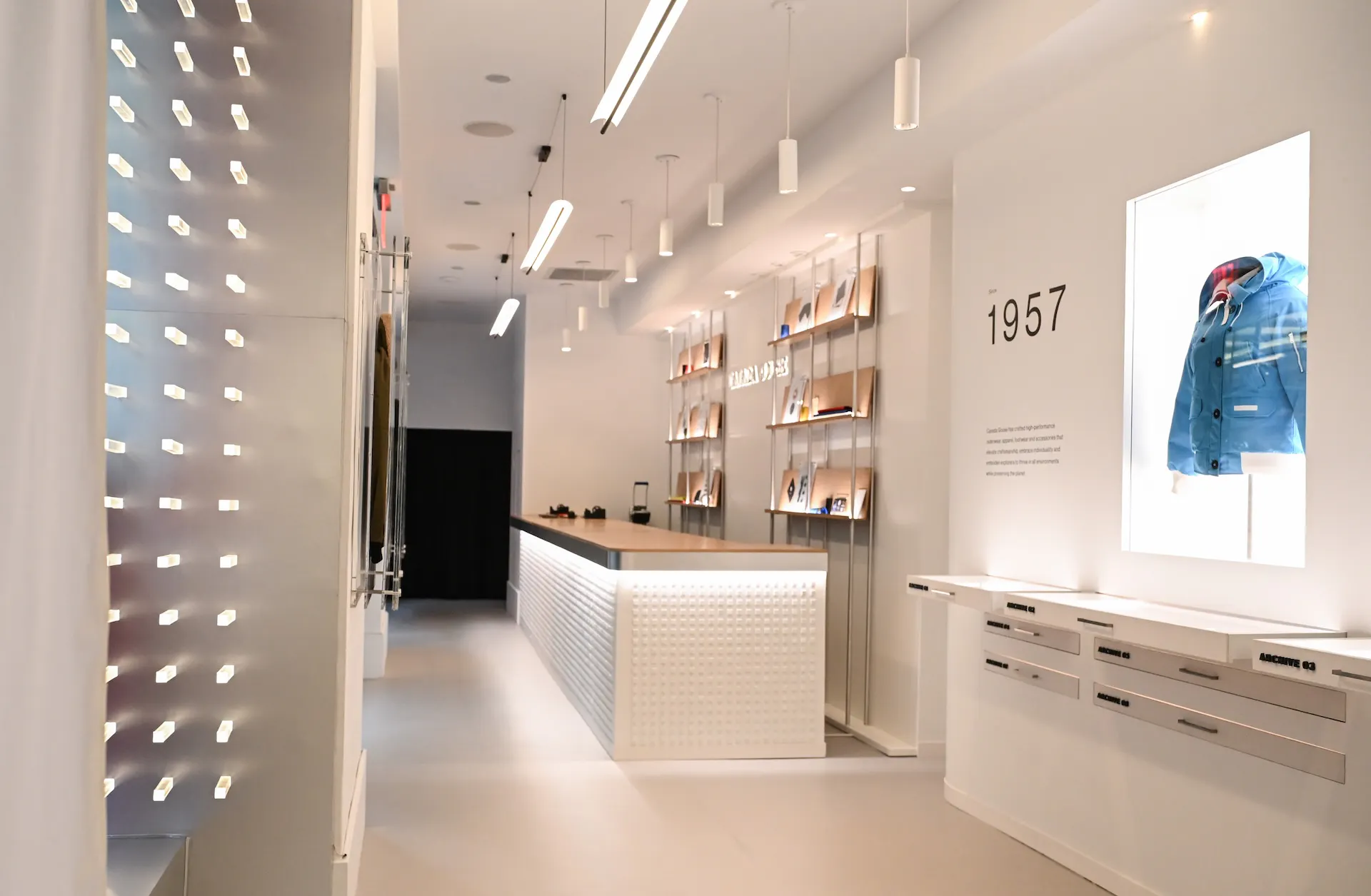
The footprint at Bloomingdale's was an unused sushi restaurant on the floor.
Most pop-up briefs in that situation pretend the previous tenant didn't exist and dress the box.
WONU's creative direction took the opposite read: don't fake a retail environment, build a brand archive that earns the wall it occupies.
The work was developed by WONU's creative direction and spatial design team.
The constraint ran in two directions at once. The shell wasn't built for selling parkas.
Canada Goose's brand story is built on craft heritage that doesn't show inside a regular shop fitout.
The build solved both problems with material specificity.
Edge-lit light tower window displays anchored the storefront, fabricated with organic fabric components that read warmth instead of cold winter-product gloss.
The interior wall was rebuilt as an exhibition-style multimedia archive.
It carried a built-in TV niche, pullout archive drawers, and a custom workshop display counter that doubled as the in-store customization station.
Custom flooring tied the room to the brand rather than to the floorplate.
The strategic outcome was access, not transaction.
The space sat inside a department store, open to walk-in foot traffic, with complimentary customizations on offer.
That created a publicly accessible heritage destination outside the standard Canada Goose retail format.
The full Born in the North build is documented on the Canada Goose project page.
Loro Piana Cocooning: when a pop-up tour becomes a series of pop-ins
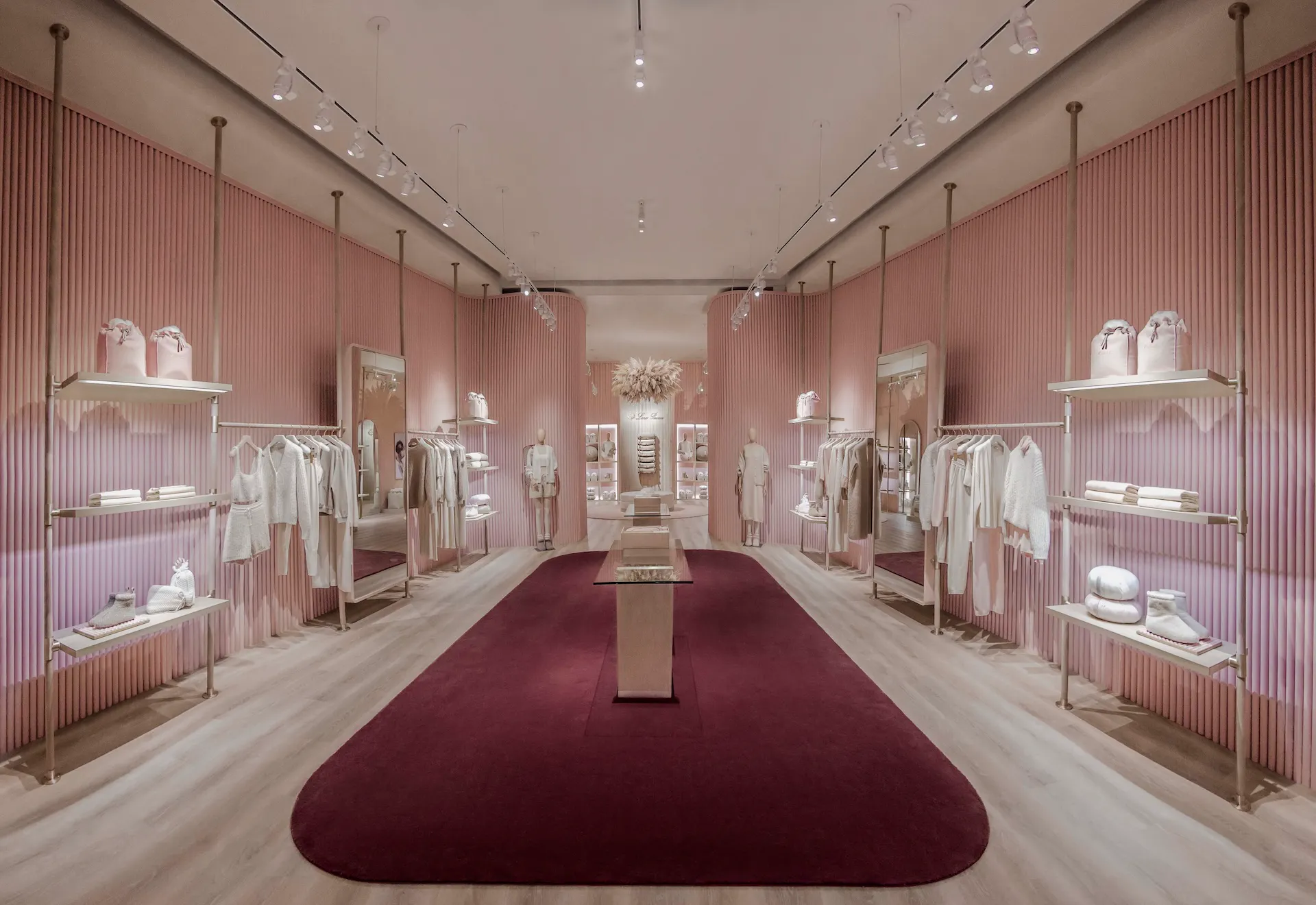
When Loro Piana launched its Cocooning Collection in October 2022, the press release didn't just announce a pop-up.
WWD's coverage of the launch reported "a series of pop-ups and pop-ins" across international markets.
Pricing on the collection ranged from $300 to $3,350. The distinction between the two formats is real and worth keeping.
A pop-up is a standalone temporary build. A pop-in lives inside another retailer's footprint and borrows infrastructure.
The two formats answer different questions about how a luxury brand wants to show up in a new market.
WONU's work on the Cocooning rollout began on Rodeo Drive at 323 N. Rodeo Drive, the same address that would later carry Fendi's seasonal rotations.
The collection itself was leisurewear designed to read as cashmere worn at home.
That set the spatial direction. The room wasn't a high-luminance retail display.
It was a tactile environment built to invite hand-touch contact with the silk and cashmere on the rack.
For more on this register of work, see the studio's notes on multi-sensory retail design.
The model extended past the single site.
Regional pop-ins picked up the same material language inside other Loro Piana store footprints across U.S. markets.
Each space was scaled to the host environment rather than rebuilt from scratch.
That tour-and-tuck logic is what separates a one-week brand moment from a months-long format that earns repeat visits.
The full record is on the Loro Piana Cocooning project page
Fendi Baguette 25th: the anniversary as an editorial install
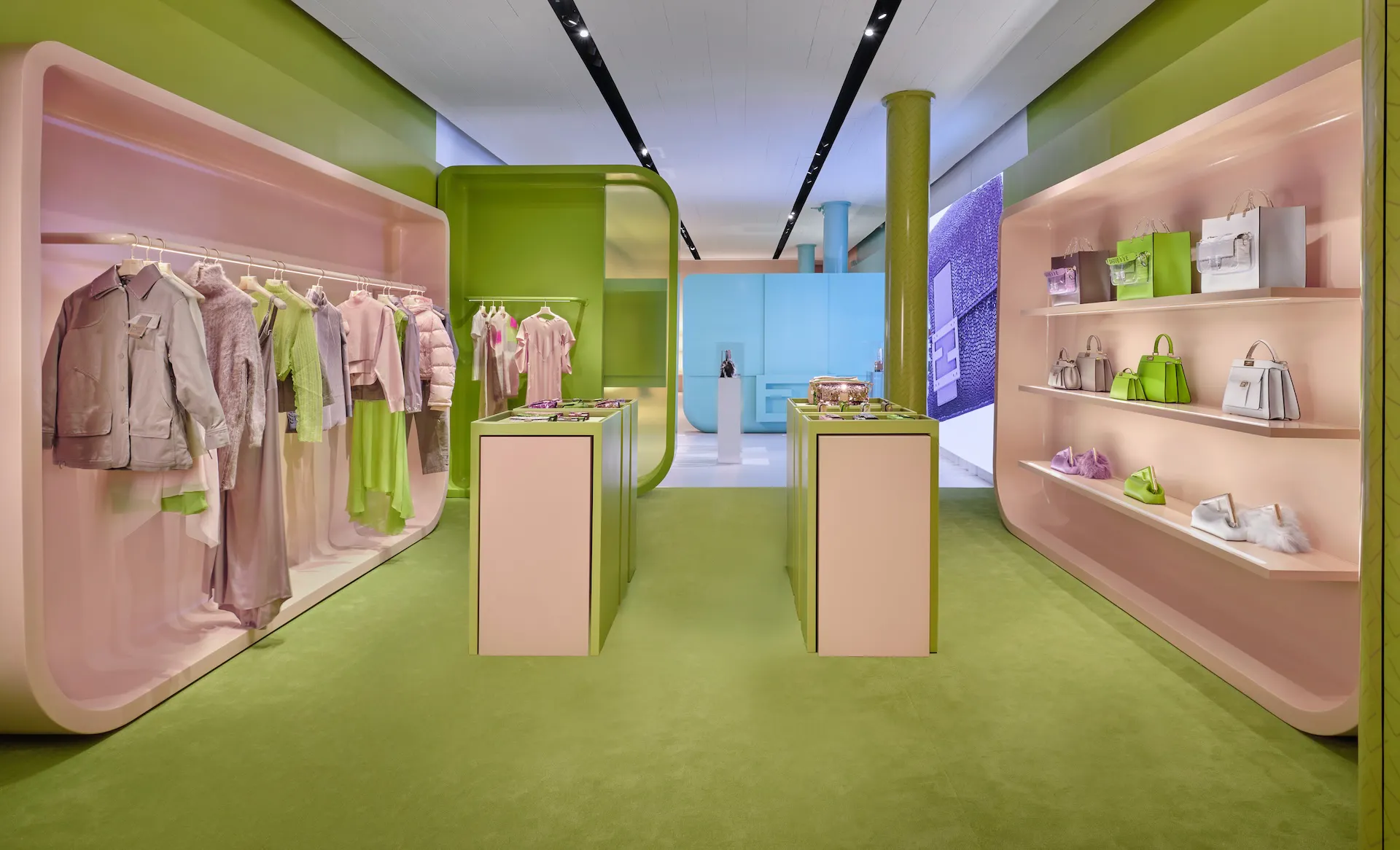
The Baguette 25th anniversary install in SoHo extended WONU's year-long Fendi pop-up partnership out of Rodeo Drive and into New York.
A heritage milestone for a single product category brings a particular constraint.
The bag is the protagonist, and the install has to read as editorial commentary on the bag rather than as a sales floor.
The brief sits closer to a curated retrospective than to a transactional shop.
The space needs to slow visitors down and walk them through 25 years of design references before it gets to the buy moment.
That logic ran the spatial decisions.
The sightline from the entry was paced so the archival bags carried the first half of the visit.
The contemporary buy surface was set deeper in.
Light fixtures were programmed to hold the leather finishes, not to flatten them under uniform retail brightness.
Soft material treatments on the walls absorbed reflection so the eye stayed with the merchandise rather than the room.
The anniversary format has held up as a category in luxury retail because the math behind it works.
Per Cushman & Wakefield's reporting on luxury retail real estate, luxury brands continue to invest heavily in physical environments specifically for the in-store experience.
Those investments include remodeled flagships with high-touch services and custom in-store programming.
A heritage pop-up earns that same logic on a shorter clock.
The full record is on the Fendi Baguette 25th project page.
Tools For Humanity, Not Bot Shop LA: when the activation has a conversion target
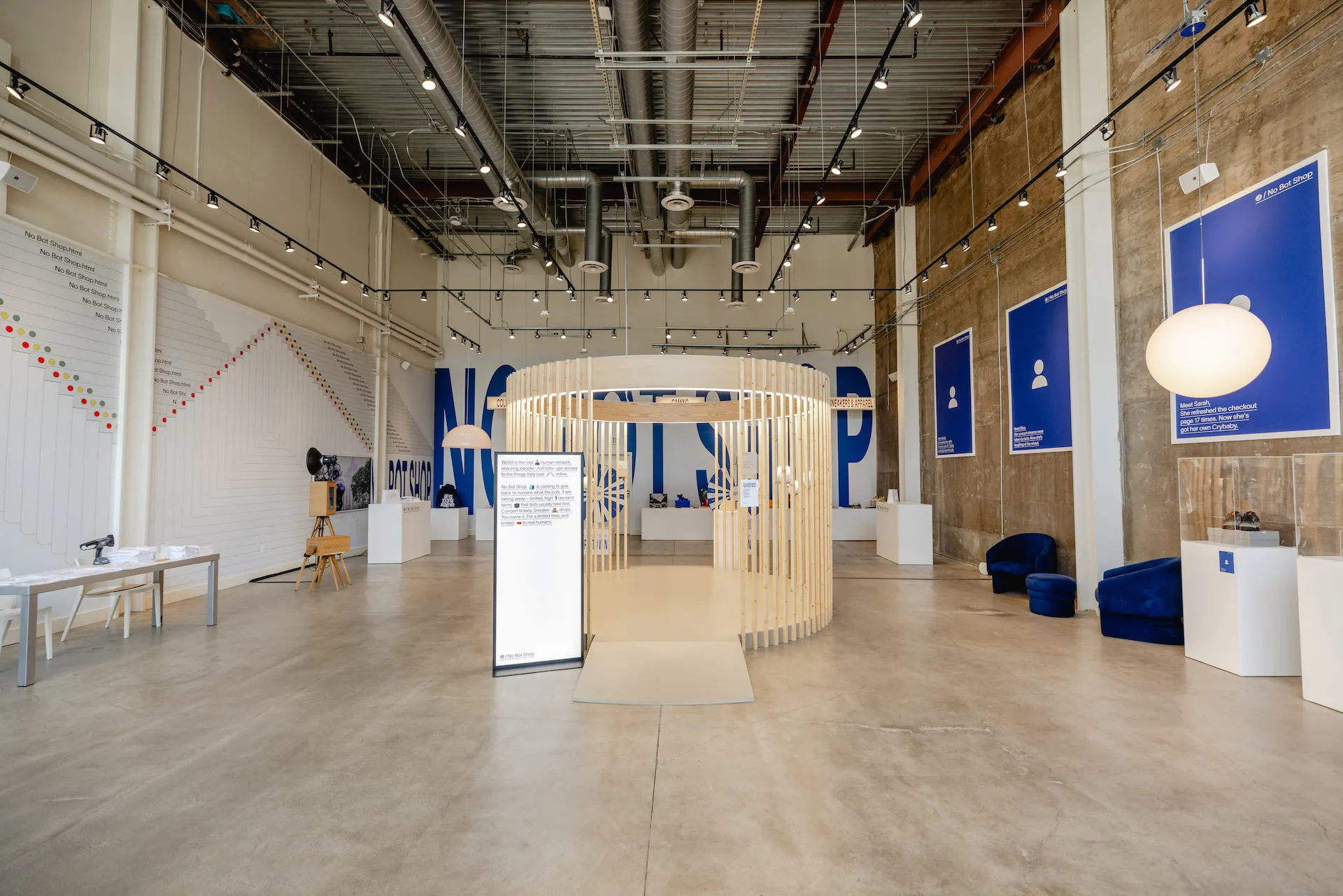
The Not Bot Shop at 8585 Melrose Avenue in West Hollywood was Tools For Humanity's first U.S. consumer activation for World.
World is the human-verification product co-founded by Sam Altman and Alex Blania.
For context on the broader U.S. rollout, see TechCrunch's coverage of the World Network launch.
The brief was different from anything else in this lineup.
The success metric wasn't dwell time or press impressions. It was World ID verifications completed at the Orb on-site.
Per the official World event page, the September 6 to 7 activation invited the first 1,200 unverified humans in line to spin a prize wheel after verification.
Limited-edition reclaimed product was on offer as the incentive layer.
The conversion job was straightforward in concept and demanding in execution.
Turn a sidewalk into a queue. Turn a queue into an Orb scan. Turn an Orb scan into a verified World ID.
WONU built the activation around that funnel.
The showroom became a gamified retail environment where each station fed the next.
The exterior carried branded queueing infrastructure, and content capture ran across the day to extend the activation past the foot traffic on-site.
That kind of brief is the type of conversion-anchored work WONU's strategy and experiential marketing practice exists to solve.
The activation's reported on-site result, per WONU's project record, was 210 verifications by 1PM.
That number ran ahead of the national 120-verification benchmark and set an internal floor for future global World activations.
For more on how verification-style metrics function inside an activation, see measuring success in experiential retail metrics.
Full record on the Not Bot Shop project page.
The build that didn't hold up: what timeline pressure does to luxury fixtures
Not every project earns the case study.
A luxury retail client we won't name brought WONU in to support the rollout of one of its collections across multiple stores.
The variable WONU couldn't move was time.
In the time-money-quality triangle that governs every fabrication job, the timeline axis got compressed beyond what the build could absorb without consequences.
The consequence showed up in the fixtures.
After delivery, units began experiencing repeated damage at the store-floor level. The repair cycles ran on a loop.
WONU stayed accountable on every repair, replaced what needed replacement, and held the relationship together through the rollout.
But the experience didn't represent the team's standard process, the fabricators' craftsmanship, or the studio's quality-assurance approach.
Jade's summary of the lesson:
"We like to get it right the first time, and that didn't happen. It was disappointing, but we learned from it. It's a hard thing to know that you didn't deliver on something, but you'll survive."
The post-mortem changed how WONU's production and project management protocols handle the store-level handoff phase in multi-store luxury rollouts.
Fixture damage in retail rollouts is more common than the trade press acknowledges.
LoopNet's coverage of pop-up retail trends cites a Cushman & Wakefield estimate of pop-up retail as a $50 billion industry.
The operational maturity of the format is still catching up to its commercial scale.
The publishable lesson is the protocol shift, not the brand name.
What separates a luxury pop-up shop design from a regular retail pop-up?
The five builds above answer the question by example.
Luxury pop-up shop design is defined less by spend per square foot than by four operational decisions that get made before the build starts.
First, fixture quality is engineered for handling, not just for opening-day photography.
Most generic pop-ups treat the fixtures as photo backdrops. Luxury builds treat them as merchandise infrastructure that has to survive store-level use.
Second, lighting is programmed to the product palette, not to the room.
The Fendi x Skims case is the clearest illustration.
Third, the format follows the brand's commercial logic.
A heritage anniversary builds as editorial. A leisurewear collection builds as a tactile environment. A tech-product activation builds as a verification funnel.
Fourth, the post-opening operational handoff is treated as a load-bearing phase, not an afterthought.
The luxury fixtures failure above is the case for why.
None of those four decisions is a budget question. All four are design questions.




Frequently asked questions
What these builds have in common
The five builds above don't share a brand category, a budget tier, or a city.
They share a design discipline.
Each one moved the work from a generic luxury pop-up framing into a specific answer to a specific question about how the brand wanted to be encountered.
That discipline is what separates a pop-up shop that opens to a queue and closes to a P&L return from one that opens to a press release and closes to a write-off.
If you're planning a build that needs to do real work, start a conversation with WONU.
Let's build
If you're thinking about how your brand shows up in the world, we'd love to hear from you.